
News & Events
Rabbi’s’ Blog
A Vision for the Future of Jewish Life: Kehillah (5 of 6)
July 4, 2025
Shabbat Shalom and Happy 4th of July! Several weeks ago, I wrote to you during the 12-day war with Iran. At the time, three of our young women—Gabi Sanderow, Sylvia Shafran, and Alaina Towne—were in Israel participating in Birthright and Onward Israel. They spent several nights hiding in bomb shelters before relocating to the Negev, a quieter region for the rest of their trip. Thankfully, they returned home about 12 days ago and are resettling. I know their families deeply appreciated the outreach they received from our community.
Jewish community is the essence of Jewish life. One can be a Jew, but it is hard to live Jewishly when you are alone. Several years ago, I worked with a young woman nearing college graduation who was interested in conversion. She had accepted a job assignment in China and hoped to be placed in a city with a Jewish community. However, her placement landed her 90 minutes from the nearest one. We spoke about the challenges of living Jewishly as the only Jew in your environment. Unfortunately, we lost touch, and I’m not sure how her journey unfolded.
When God created Adam, God said, “It is not good for a person to be alone.” God knew we are meant to be with others. As a people, we walked hand in hand through the parted waters of the Sea of Reeds. That experience was not only about freedom—it was about shared freedom. At Sinai, we responded to God’s teaching with one voice. God made a covenant not just with the individuals present but with every generation to come. The rabbis teach in Pirke Avot that when two people study Torah together, God’s presence dwells among them. When we pray, we form a minyan—a gathering of souls creating shared spiritual space.
More than community alone, we need to become a kehillah kedoshah—a sacred community. Sacred communities unite in joy and in sorrow. After the building of the Golden Calf, Moses called the people together. This gathering helped them heal. They used the same materials from the idol to build the Mishkan, and that act of collective building brought wholeness. We need community to say Mourner’s Kaddish, to become B. Mitzvah, and to marry. We need one another to celebrate and to grieve.
When we pray together, something powerful happens. The shaliach tzibur (service leader) invites us: “Barechu et Adonai ham’vorach,” and we respond: “Baruch Adonai ham’vorach l’olam vaed.” This call and response becomes a symphony of voices—speaking to God and to each other. Ahad Ha’am once said, “More than Israel has kept Shabbat, Shabbat has kept Israel.” I believe this teaches not only about Jewish law but about the sustaining value of community. On Shabbat, we come together to eat, pray, celebrate, and study. Through these sacred acts, we invite God’s presence into our lives.
On Wednesday, Rabbi Karen Martin officially joined Beth Tikvah as our Assistant Rabbi. This is truly a shehechiyanu moment! We are excited to get to know her more in the weeks and months ahead. Her presence will enrich our community in many ways. Join us tonight for our recorded Shabbat prayers. Next Friday, Rabbi Martin will lead services, and on July 18, we’ll hold her official welcome celebration.
Have a wonderful 4th of July weekend!
Shabbat Shalom,
Rabbi Rick Kellner
A Vision for the Future of Jewish Life: Peoplehood (4 of 6)
June 27, 2025
As I sat in the Charlotte airport Wednesday evening, patiently awaiting a flight home that was significantly delayed, I turned to my right and there were two ultra-Orthodox men sitting there. I debated whether to turn to them and say, “Hey, I am an MOT (Member of the Tribe).” The only thing that might have given it away was my Bring Them Home necklace. We never said anything to one another. As the delay increased, two women sat next down next to me, and I was convinced I heard Hebrew. But then it wasn’t Hebrew. Maybe it was Russian; and then there was English, then Hebrew again. One of the women wondered why there was no plane. I turned to her and said there was a plane. I had my opening… “Aten meYisrael? Are you from Israel I asked?” I am sure the last thing they expected out of my mouth was Hebrew. Surprised, one of the women answered, “I was born there but I now live in Canada.” I told her I was a rabbi, and she then said, “It’s nice to be with some of our people.” The moment reminded me of a song I would sing growing up in religious school written by my friend and colleague, Rabbi Larry Milder, “Wherever you go there’s always someone Jewish, you’re never alone when you say you’re a Jew.”
We’ve been living in a time where it has been so challenging to be Jewish. These moments echo the prophet Balaam’s words that we are a people who dwells alone. The silence of friends in some of the most challenging moments has only further emphasized these emotions. However, the time when I least feel alone is when I am at Beth Tikvah or in other Jewish settings. I can be my authentic self without worrying about judgment from others. Of course, there are moments when I might find myself in disagreement with others about Jewish law or the best future for the State of Israel; but at the end of the day, I know that we stand together in times of grief, pain, and sorrow.
Therein lies the essence of Jewish peoplehood. We are a family and a people that share an eternal covenant. Our origins come from being a family in the book of Genesis, and quite the dysfunctional one at that. Even though the individuals are deeply flawed, they are all part of the family, and regardless of what they do, they cannot be cut off. In the book of Exodus, Pharaoh first calls us a people, and he is afraid of us. We share pain in bondage, joy in our freedom, awe as Torah is revealed, and responsibility as we share in the covenant.
As I think about these last 20+ months, I think about how I have once again found my people. Together we have felt pain, we have celebrated moments of joy, we have joined for learning, song, and prayer. While I wish it would not take turmoil to bring us together, perhaps it is in the moments of turmoil that the ties which bind us together become stronger.
When I graduated High School, I went on my NFTY in Israel trip, but first we stopped in the Czech Republic to explore our history and visit Terezin, the model Concentration Camp that was used to show off to the Red Cross. While there, we sang the song The Last Butterfly, based on a poem by Pavel Friedman. At the end of the song we sing, “But I have found my people here…” It is a powerful reminder that there are so many moments that bring us together.
Rabbi Donniel Hartman teaches us that we are the sum of the stories we tell about ourselves. As a Jewish people, we must know our stories and we must share them. Ask your family members about their stories. Where did they come from? What is important to them? Why did they bring the sacred objects they brought? Whether we come from Buenos Aires, Brussels, Brooklyn, Be’er Sheva, or Be’eri, or Central Ohio, we are part of the people. We stand together in times of great need. It is why we felt such deep pain and concern when ballistic missiles fell on our cities in Israel in these last several weeks. And it is why we are called together to bring healing and hope to a future that desperately needs us. As we move forward, we will learn our stories, we will learn our tradition so that we can fulfill what is perhaps our most important obligation l’dor vador, passing on our tradition from generation to generation.
In the last twenty months, one of the best symbols describing Jewish Peoplehood was a poem written by Israel poet Racheli Moshkovits entitled a Coat of Many Colors.
My son returned from battle, his duffel bursting
With things that I had not packed for him.
Socks donated by the Jews in Argentina.
A quilted blanket smelling like someone else’s home
A blue towel from a family from the Moshav,
Tzitzit from Jerusalem.
A fleece jacket, gifted by a high-tech company,
A scarf knitted by an elderly lady,
Undershirts purchased by online shoppers,
A sheet that was given to him by a friend,
Gloves bought by teenage girls,
A jacket from the closet of someone who
Came and requested to give.
I spread out all those garments
And weave together a new coat of many colors.
See, Yosef, your brothers were there for you.
Shabbat Shalom,
Rabbi Rick Kellner
This is the fourth installment of my reflections on Jewish values that will shape the future.
A Vision for the Future of Jewish Life: Zionism (3 of 6)
June 20, 2025
It continues to be a challenging moment for the Jewish people. In addition to being on faculty at camp, tending to work emails and commitments from afar, I have been called to continually check in on family and friends in Israel. To quote the 12th century poet Yehuda HaLevi: “My heart is in the East, and I am at the edge of the West.” I am not sure if there has ever been a time in my life when I have thought as much about Israel as I have during these last twenty months—except for when I was living in Jerusalem, walking the streets and alleyways, surrounded by buildings of Jerusalem stone that shine in the hot sun.
When I arrived at Beth Tikvah, I started a discussion group about Israel. Over several years, we met monthly at Panera; I sent out articles and we discussed our opinions. Rarely did we speak about Zionism or its origins. Though I had traveled to Israel before entering high school and felt an immediate connection to the land and the people, I am not sure I truly understood the concept of Zionism. I had an incredible 10th grade social studies teacher who, for extra credit, encouraged us to watch historical films and write reflections on them. I remember watching “The Life of Emile Zola”, a film about the infamous Dreyfus Affair when French military officer Alfred Dreyfus was wrongfully convicted of treason. A young journalist, Theodor Herzl, covered this case and because of the antisemitism he witnessed, he knew that Jews needed to have a Jewish State of their own.
When I teach young people about Zionism, I tell them that “Zionism is the national movement of the Jewish people to establish a Jewish home and to have sovereignty in the land of Israel – the ancestral home of the Jewish people from the time of Abraham.” The concept of Zionism emerged because Herzl knew in the late 1800s that Jews would never be fully accepted living in another land. We needed a home of our own. I also now must teach people that any definition of Zionism outside of this definition has been created by others to delegitimize the Jewish community and the Jewish state. Much of what our young people learn today on TikTok reflects such a distortion.
This week, I learned of a quote from Walter Russell Mead, an American academic, who said, “Zionism was not the triumphant battle cry of a victorious ethnic group, but a weird, desperate stab at survival.” Teaching about this quote, Noam Weissman (Jewish educator and CEO of Unpacked for Educators, an incredible resource for Jewish learning) reflected that now, more than 77 years after the founding of the State of Israel, the fact that we still have to make these desperate stabs is both heartbreaking and awe-inspiring. In the immediate aftermath of the attack on Iran, Rabbi Donniel Hartman and Yossi Klein HaLevi reflected that these attacks are the ultimate expression of Zionism. Why? Because when facing an existential threat—as derived from Iran’s many decades of rhetoric against Israel and the Jewish community, Israel acted to preserve the existence of the Jewish people.
Perhaps these scholars have uncovered the true essence of Zionism. It is not about power; it is not a means to denigrate or be superior over another group of people. Zionism is an attempt at Jewish survival. And for 77 years after we established a state of our own, we have been fighting for our survival. For decades, we have faced external threats from foreign militaries, terrorist organizations, and dangerous ideologies. That continues to be the story of the Jewish people. Even with our own homeland, we must continue to fight for our survival.
This is the third installment of my reflection on our values. Please visit my Rabbi’s Blog to read about the values of B’tzelem Elohim, loving the neighbor, and loving the stranger. In some ways, Zionism is also an expression of love—love of our own community and the Jewish people. In these fragile moments, we pray for the safety of our people, the courage of our IDF soldiers, the return of the hostages, and a hope that peace will come speedily in our day to all the inhabitants of Israel.
Shabbat Shalom,
Rabbi Rick Kellner
A Vision for the Future of Jewish Life: Loving Our Neighbor & The Stranger (2 of 6)
June 13, 2025
Last evening, we learned that the Israeli Air Force, launched a preemptive defensive military strike on Iranian nuclear sites along with Mossad efforts to disable Iran’s ballistic missiles. Israelis spent the night in their bomb shelters preparing for a response from Iran. Iran has called for the destruction of the State of Israel numerous times. We pray that this will limit their nuclear capabilities so that will never happen. With the words of Psalm 122 on our hearts, “we pray for the peace of Jerusalem.” Our thoughts and prayers are with all those in Israel, especially our Beth Tikvah members, family, and friends, who have spent the night with fear on their souls. We pray for the brave IDF soldiers who are defending Israel and our people. We send them our love and strength.
L’shalom,
Rabbi Rick Kellner
The message below was the original message for this week.
How can we be commanded to love? This question is one we ask if we believe that the Torah is commanding us to hold an emotion. Love, however, is a verb, it calls us to act. There are moments when we gather to pray and sing, olam chesed yibaneh, the world was built from love. If the building blocks of the world come from love, we need to take those building blocks to build a sukkah of shalom to embrace the vulnerable and send hope to those in pain.
Jewish tradition commands us to love our neighbor – Rabbi Akiva and Rabbi Hillel, both teach us that this commandment is the most important commandment in the entire Torah. In order to understand its lesson, we need to look at the Hebrew – ואהבת לרעך כמוך – v’ahavta l’reiacha kamocha. Hebrew grammar would come to teach us that the word that would typically follow the command to love would be את – et, indicating the object of the verb. However, here, the preposition “ל-l’” indicates moving towards something, towards a vision for the future. That vision is one that includes loving our neighbors. We do this through actions, including tzedakah or other acts of loving kindness. Jewish tradition defines neighbor in a multitude of ways. We might begin thinking about those most like us, our family, the greater Jewish community, or Jews living around the world. However, the Talmud offers an alternate opinion. It teaches us that we can help those living close to us whether they are Jewish or not. The notion to love a neighbor ties directly to the notion that we are created b’tzelem Elohim – in God’s image. To behold another’s face places a demand on us that calls upon us to recognize that person as sacred.
Our love does not only extend to our neighbor, but a core command of the Torah is to love the stranger. The rabbis of the Talmud remind us that the command to care for the stranger appears 36 times in the entire Torah including in Deuteronomy 10:18-19 where God is extolled for being might and awesome, upholding the cause of the orphan and the widow, loving the stranger by providing food and clothing, and concluding with the command to love the stranger. It is not limited to Deuteronomy, but the purpose is to sensitize us to the plight of the foreigner and refugee who lives among us. We were strangers in Egypt and our ancestors were once strangers seeking refuge from antisemitism and turmoil in their homeland. In every generation, we live and relive the Exodus. We see ourselves as if we came forth out of Egypt. Rabbi Shmuly Yanklowitz reminds us, “To be faithful is to orient our lives around the needs of the most vulnerable. The stranger, widow, and orphan can be understood conceptually. The mitzvot that are articulated with reference to widows, orphans, and strangers apply to all those who are marginalized, alienated, oppressed, and suffering.”
As I sit this week and see those who are strangers and immigrants suffering, I am heartbroken by their pain. In my communications with a Los Angeles colleague this week, he reminded me that there are Latino members of the Jewish community who are impacted by this. Why did he feel the need to do that? Sometimes we tend to think such moments affect other people, but they affect Jews as well. We should not need that reminder, however. Shouldn’t the fear of being separated from one’s family and being swept off the street be enough to tug on our heart strings and make us want to support those in need? Such a moment transcends policy; it causes us to think about how policy impacts human beings. When human beings need our help, Torah is revealed to us calling on us to act. Click here to see the CCAR’s most recent statement.
While we have a core responsibility as Jews to tell our stories and immerse in Jewish ritual and Jewish learning, the ideals of Torah remind us, repeatedly, to reflect on our core Jewish responsibility to think about how we might act to make the world around us better. We begin as individuals within our own community and extend outwards. The Torah reminds us again and again that human dignity matters. As Jews, we are called on to be a light to the nations. Thinking about our vision moving forward: upholding human dignity, loving our neighbor, and caring for those who are marginalized are key components of building our world from love.
Shabbat Shalom,
Rabbi Rick Kellner
Read Rabbi Rick Kellner’s previous post on being created in God’s Image.
Watch Rabbi Rick’s Annual Meeting Update: A Vision for the Future.
And You Will Guard Us
June 6, 2025
J’accuse – I accuse much of the world of turning its back on Jews, the Jewish people, and the Jewish community.
J’accuse – I accuse much of the world of succumbing to the algorithmic mind-shaping of the media.
J’accuse – I accuse much of the world of molding modern-day Israel into the fold of historical perceptions of the evil Jew, as happened in much of historical Europe.
J’accuse – I accuse much of the world of accusing every Jewish person of being responsible for the actions of a corrupt Prime Minister, with whom nearly 70% of Israelis disagree.
J’accuse is, of course, a reference to the famous open letter written by Emile Zola, a French writer, published on January 13, 1898, on the cover of a French newspaper. In the letter, Zola argued that the conviction of French army officer Alfred Dreyfus, who was also Jewish, was based on false accusations of espionage. He highlighted the poorly conducted investigation and showed that if the investigation had been done properly, the evidence would have shown the guilt was from another officer, not Dreyfus. The Dreyfus affair was a watershed moment for the Jews in Europe. For Theodor Herzl, an Austro-Hungarian Jewish journalist and the founder of modern-day Zionism, that was the moment he realized that, for Jews to be safe, they needed a state of their own. Jews were never safe in Europe, and 40 years later, Herzl’s fears came to life with the genocide and mass murder of our six million.
Jewish life in America was always different. The United States of America, in addition to breaking off from the King of England, also sought to deviate from the Anglican Church of England. This was so important to our Founding Fathers that the First Amendment to our Constitution guarantees that our “government shall not make any laws respecting an establishment of religion, or prohibit the free exercise thereof; or abridging the freedom of speech, or of the press; or the right of the people peaceably to assemble, and to petition the Government for a redress of grievances.” Freedom of religion was a primary pillar of the establishment of our country. While these amendments were ratified in December of 1791, President Washington, in his famous letter to the Temple of Newport, Rhode Island, wrote a year earlier in 1790, “May the children of the stock of Abraham who dwell in this land continue to merit and enjoy the good will of the other inhabitants—while everyone shall sit in safety under his own vine and fig tree and there shall be none to make him afraid.”
And none shall make them afraid… but 230 years later, we are afraid. On the first night of Passover, in the name of Gaza, a terrorist burned Gov. Josh Shapiro’s Governor’s Mansion hours after their seder. Two weeks ago, two young Jews, Sarah Milgrim and Yaron Lischintzky, were murdered outside of an American Jewish Committee event for young diplomats to encourage interfaith efforts to bring aid to Gaza. The perpetrator, Elias Rodriguez, when arrested, yelled “Free Palestine” and railed against the war online. He not only waited outside the event to shoot these young people—he pursued Sarah, who tried to crawl away, and shot her countless times. Just 10 days later, at a walk for the hostages in Boulder, CO, an Egyptian man, in the name of “Free Palestine,” firebombed a crowd of mostly seniors. Yelling “Free Palestine” and hurting American Jews will not free Palestine. It will not bring about an end to the war, and it is most certainly not an American way of behaving.
One of the victims in Boulder was Barbara Steinmetz, an 88-year-old Holocaust survivor from Hungary, who said in an interview this week, “We’re Americans, we are better than this. That’s what I want them to know. That they be kind and decent human beings.” She added, “The attack has nothing to do with the Holocaust, it has to do with a human being that wants to burn other people. It’s about what the hell is going on in our country, what the hell is going on?” Her father fought for Jewish assimilation in Hungary, but Jewish wisdom and ritual were a huge part of her life. Her mother was a chemist but had to sit in the back of the class because she was Jewish. Her father spent many years running a hotel in Croatia. When he saw what was coming, he reached out to many former hotel guests for help, but no one would help. The family finally escaped to France, Spain, and then Portugal, where he worked to find asylum in many countries. Finally, they journeyed to the Dominican Republic.
Moments such as this activate the inherited trauma we experienced, our families experienced, or that which we read about and know happened to our people. Antisemitism in America is at an all-time high—up nearly 900% from a decade ago. And the vision of America is that “none shall make them afraid.” Washington’s vision can only hold true if Americans collectively join to denounce such hateful actions.
For months, leadership in the Jewish community raised concerns about slogans appearing at rallies which included “Globalize the Intifada” or “There is no solution except intifada revolution.” When these phrases are put into action, they look like murder, firebombing of Jews, and attacks on Jewish institutions. The massacre at the Tree of Life synagogue changed Jewish life in America. For Jews, we saw it as a different form of antisemitism that never occurred here before. For many Americans, who saw this as another attack on a house of worship and denounced it then, they also aligned it with the treacherous wave of gun violence and mass shootings that has marred 21st-century American life. Those who see this as another mass shooting risk never seeing it for what it is—a man who was solely motivated to kill Jews and was informed by antisemitic conspiracy theories.
I am struck by the deep sadness, anger, and fear that has consumed my soul this week and the alignment with Parashat Naso where we read the Birkat Kohanim, the Priestly Blessing: “May God bless you and protect you. May God’s light shine upon you and be kind to you. May God lift up God’s face to you and grant you peace.” May God protect you. Protection is a word we come to associate with security. Our community is all too familiar with asking for protection from our wonderful police officers who stand with us in our hour of need. Bekhor Shor, a 12th-century French commentator, likens these words to the 121st Psalm in which we read God will guard us from all evil. In response to such horrific acts of violence, we might wonder where God’s presence is. God’s presence relies on Barbara Steinmetz’s vision of America—and really the world—in which there is hope for goodness to prevail over wickedness. God’s blessing requires all humanity to do their part. Perhaps this hope is underscored by Nachmanides, a 12th-century Spanish commentator who compared God granting us kindness to a midrash in Genesis Rabbah that says, “O My World, O My World! Would that the quality of grace be before Me at every moment.” It seems that the rabbis recognized God’s secret hope and prayer: that God’s hand in creation would bring compassion, love, and peace to the world.
American Jewish life has traveled a path that has wound its way from being a minority on the outskirts to being accepted into the most important aspects of society. We have been elected to high offices, served as leaders of major corporations, and been appointed to the Supreme Court, and yet once again, we recognize our fragility because we realize we are a minority. Our commitment to learning and work ethic brought our immigrant ancestors into the fold of American life very quickly. Yesterday, as I stood at Plum Street Temple in Cincinnati, a synagogue built by Isaac Mayer Wise in 1866, I learned from Rabbi Neil Hirsch, the senior rabbi, that there are only three Stars of David in the entire synagogue—one atop the ark and two that frame the Ten Commandments high above the ark. The other stars in the building are five-pointed stars mimicking the American flag because Wise was deeply committed to Jewish life in America. He wanted the synagogue to be American. As we do this dance between acceptance and outcast, perhaps what we need is something new. We often speak about Tikkun Olam—repairing the world—but maybe we need something different. Maybe we need a Tikkun N’fashot—an effort to repair souls. The great modern Mussar teacher explains that the nefesh, one of the words for soul, is the aspect of the soul most visible to us. It is where all of our character traits like anger, love, trust, worry, and kindness reside. Morinis explains the nefesh part of our soul registers all the good and bad we do in our lives. What would it mean to repair it? It would require a profound effort for every individual to examine themselves and ask profound questions.
I began tonight referencing Zola’s J’accuse. Israel and the Jewish people have been accused of horrible things. And when we claim that being called colonialists and committers of genocide is antisemitic, those who claim it say they love Jews and deny it. Maybe the accusers need to study more history and recognize their claims align with the blood libel of the past. And maybe they will realize that, like every generation before now, the Jew has become what is considered most evil in society. And this has happened again!
We hate being the victim. We hate what the trauma does to us. When the world looks to us and says, “We accuse you of destruction and starvation,” will the world believe us when we say Hamas stole the aid, Egypt closed its borders, Hamas put its operatives in schools and hospitals and ensured their families would be right next to them? Would the world remember that part of Hamas’ strategy is harming its own civilians? All this is a forgotten part of the story. Perhaps it is intentionally ignored. Every death is a tragedy. When a child dies, it brings me great sadness. I want nothing more than for our hostages to come home, this war to end, and for Hamas to never pose a threat to Israel again. But harming Jews in America will not bring that about. Our Tikkun Hanefesh will come when we wonder if we did all we could to bring home the hostages. It has come when we recognized the mistakes that were made during this war. And it will continue to come when we strive to build Zechariah’s vision: when the old shall be in the squares and the young shall be able to play in those squares.
In 2024, Rabbi Oded Mazor, a Reform rabbi in Jerusalem, shared a vision of the future. He sends his children to the Yad b’Yad school, a multilingual school where Jews, Arabs, and Palestinians come together—they are students and teachers. He was told an incredible story by one of his kid’s teachers. “In another class, the Jewish teacher was teaching, and the Muslim teacher was there with her. One of the grown children of the Jewish teacher walked in the room in uniform, having come back home from the army. He asked his mother to go out with him for a coffee. His mother told him, ‘I can’t go. I’m teaching now.’ And the Palestinian teacher said, ‘Of course you should go with him! He’s your son! He came home!’” She understood that as a mother, even though that son came into the class in uniform—and one can only imagine what that meant for the Palestinian teacher—that mother had to go with the son who came from the battlefield. What they didn’t know was that the reason he came to get her to go out for coffee was that, at the coffee shop, the other son, who came home from miluim (reserve duty), was waiting. He concluded by saying that after Purim ended, he would have an Iftar dinner in his synagogue courtyard for the children in his daughter’s class.” That is the day he waits for.
The day I am waiting for is the day we do not have to have a police officer in our lobby because the world realizes that Jewish lives matter too. The day I am waiting for is knowing that I don’t have to think about where I might go if I had to pack my bags. The day I am waiting for is not having to wonder who will hide me if the world turns its back on me again. The day I am waiting for is for all to recognize that we are part of the fabric of America, where we can all sit beneath our vine and fig tree and none shall make us afraid.
Shabbat Shalom
Rabbi Rick Kellner
A Vision for the Future of Jewish Life: B’tzelem Elohim (1 of 6)
June 6, 2025
As a Jewish leader, I spend time immersed in Jewish life, Jewish history, and the profound lessons of Torah. I also spend time listening and speaking with many of you, along with learning from other Jewish leaders. I have spent much time immersed in what the future of Jewish life will look like.
October 7th changed Jewish life in the 21st century. After twenty months of war, we are filled with deep questions about what it means to be in a perpetual state of war. We know that antisemitism is rising, and we know that participation in Jewish life around the United States, including in Columbus and at Beth Tikvah, have surged since the war. We are looking for community, we are looking to be heard.
My own questions have centered on our own community and what we can become. I have thought about:
- How can we enrich our Jewish identity?
- What are our values?
- How do those values play out both within and beyond the walls of our synagogue?
- What is our connection to Israel and the Jewish People?
- How can we live out our Zionism?
- In a world in which we feel deep loneliness resulting from antisemitism, what can we do to make the world a better place?
Over the course of these next several weeks, I want to begin to share with you my responses to these questions. During my February sabbatical I spent time in study and reflection and crafted what I would call a “living and fluid vision” for the future of Jewish life and how Beth Tikvah can immerse in that vision. For the first six weeks, I would like to reflect on the Jewish values that can be the fuel that fills the engine of Jewish life. Subsequent to a conversation on values, I would like us to think about how we apply those values to our lives and our community.
We begin with B’tzelem Elohim to be made in the image of God.
In the beginning of God’s creating the world, the Torah teaches us that we, human beings, are created in God’s image. With this distinction of the highest esteem, it serves as a calling to us to see others with a divine spark of creating. The value is repeated several chapters later when God creates the world anew; starting with Noah and his children. Even as God realized the depravity of humankind prior to the flood, God began the world again with the same value. The failure of human beings to behave in the aspirational manner reflecting the divine spark within all humankind was not enough for God to eschew this value in the reboot. To underscore this point, God makes a covenant with Noah and his descendants – a promise about the future built on care and respect for one another. The Rabbis of the Talmud enumerated this covenant as they established the Noahide laws. In tractate Sanhedrin (56a) the Rabbis begin to envision what such a covenant might look like. To live this covenant is to recognize this universal vision for all humanity: The children of Noah were commanded with seven commandments: [to establish] laws, and [to prohibit] cursing God, idolatry, ensuring sacredness in our relationships, bloodshed, robbery, and caring for animals and all God’s creation.
The rabbis in Tractate Sanhedrin also wonder why Adam and Eve were created alone. They conclude that it was for the purpose of maintaining peace among people so that one person cannot say to another, my ancestor was better than your ancestor. This text in Sanhedrin is a foundation for a Jewish pursuit of equity between people. So much of the world is built on false notions of superiority of gender, race, status, or class. The rabbis teach us that this cannot be true because we all derive from Adam and Eve, the first human beings. We want to be seen in this light and we also must see recognize the divine spark in others.
As we enter this Shabbat and we continue through Pride month, I ask all of us to consider what this value comes to teach us? How can we live by it? And how can we remember it when we interact with others?
Shabbat Shalom,
Rabbi Rick Kellner
A Response to the Boulder Attack
June 3, 2025
I am sitting down to write this message to you on Monday afternoon, which is the afternoon of Shavuot—the day we celebrate standing at Sinai to receive the gift of Torah. It is also 24 hours after the heinous antisemitic attack in Boulder, CO, on Jews walking to encourage the release of the hostages. My heart goes out to the victims as we pray for their recovery. It is the second attack on Jews in American streets in the past two weeks, and this one has left me reeling because the emotions of the two are compounded. I am also saddened by the lack of outreach from anyone, anywhere, in the interfaith community.
Yelling “Free Palestine” and “End Zionists” while hurling explosives at Jews should fill every American with anger and inspire all of us to stand up and say, “We won’t let that happen here ever again!” When anti-Israel and anti-Jewish protesters gathered on college campuses and said “Globalize the Intifada,” this is what they were talking about. I lived through the Second Intifada. I know what it’s like to walk next to a bus or into a supermarket or sit down at a café in Jerusalem, always looking over your shoulder, fearful that it might explode. Killing or hurting Jews in America will not “Free Palestine”; it will not help Palestinians. The victims in Sunday’s attack were between the ages of 52 and 88; the 88-year-old was a Holocaust survivor. Can you imagine? She endured the worst evil humanity has ever known, and on the free streets of America, she was terrorized again for being Jewish.
In this moment, I am reminded of a Midrash (a story or interpretation about something in the Torah) about Abraham and a test of his identity and faith. The rabbis tell us a story about Nimrod, who challenged Abraham and said they should worship the fire. Abraham responded, “Perhaps they should worship water, which quenches fire.” Nimrod acquiesced and said, “Let’s worship water.” Then Abraham challenged him again and said, “Let’s worship the clouds, which hold the water.” The seemingly circular conversation continues and frustrates Nimrod, who scolds Abraham for piling on words, before saying they should bow to the fire. Nimrod said to him, “I shall cast you into the fire, and let your God come and save you from it.” Abraham was thrown into the pit for his belief and identity, and he survived. On Sunday, Jews were literally thrown into the fire of a Molotov cocktail, and we ask ourselves: will we emerge like Abraham?
The Midrash tells us that it was God who saved Abraham. For us, it might be God who will come to save us, but perhaps it will be the choices we make. When we are thrown into the fiery furnace, it is easy to run away from the flames and retreat to our own homes. Judaism has prevailed for centuries because so many of us chose not to hide. Conversos hid their identities from the public but still practiced Judaism at home. Other communities decided that even amid the fears at the hands of Czars or other oppressors, they would not give up. On Sunday evening, I taught such a lesson from Rabbi Kalonymos Kalman Shapira, the Rabbi of the Warsaw Ghetto, who illegally brought his community together inside the ghetto under the threat of death. In February 1942, he taught about how the hope for immediate salvation might actually make us hopeless, and he reminded us that salvation may just come later, and we should keep hoping and keep living our lives Jewishly.
It is my hope that we, as a Jewish community, will continue to show up! Please show up for Shabbat on Friday to honor our board. Please show up for Shabbat on June 13th to celebrate Pride. Please show up to watch the film October 8 on June 11th. If we are offering a program, please consider showing up! Safety and security are our top priority. If you have questions or concerns about our security protocols, please reach out to Debbie Vinocur, our Executive Director. We do not publicize our plans for security reasons, but she would be happy to speak with you.
These are difficult times that stir in us profound emotions and deep questions. We are all navigating these uncharted waters—hopefully together. May we all have the strength to step forward with love and not with anger.
With profound sadness and filled with prayers for all the victims,
Rabbi Rick Kellner
A Winding Road of Jewish Memory
May 30, 2025
We enter a wilderness; every step on the journey takes a winding path. We are led deeper towards a future filled with hope, but also filled with individual moments of uncertainty. The winding path takes us to places like Rephidim, Zin, Kadesh, and Mt. Hor. Our history also winds its way through places like Babylonia, Rome, Kishinev, Toledo (Spain), Warsaw, Kyev, and New York. In every generation, the journey has been filled with challenges – from the attacks of Amalek to the Inquisition, to pogroms. Carrying history in the rucksacks of our memories, we come to a time where the wilderness feels deep, and the journey home is long.
This week, in Toronto, Beth Tikvah members, along with our broader Jewish community in Columbus, entered a wilderness of memory that began with dancing and ended with shouts of tzeva adom, red alert, and running in fear. 414 souls didn’t come home alive. We had the honor of visiting the Nova exhibit, with gratitude to JewishColumbus and the Wexner family.
We were transported to the morning of October 7, 2023, in Re’im in the Western Negev. What began in dancing and joy ended in terror. At 6:29 A.M., the attacks began. On the sandy floor of the exhibit, video screens show Hamas terrorists aiming their guns indiscriminately. One chilling audio recording plays a terrorist telling his father, “I killed a Jew, I killed ten Jews, with my bare hands. Go on WhatsApp and look.” They were murdered because they were Jews. Nothing more.
The exhibit then leads through a campground scattered with teddy bears, water bottles, and signs pleading for peace. We stood next to the bar and bullet-ridden port-a-potties, on Road 232 surrounded by burnt cars, and in roadside shelters where partygoers tried to hide—now turned into memorials. In those shelters, we imagined the stories of Aner Shapira, Hersh Goldberg Polin, and Yuval Raphael. Nova is now etched into our people’s collective memory.
Upon arriving at the exhibit, we heard from Ofer and Sara Leor whose son, Matan, was murdered at Nova. He supported cancer research and then became a sound engineer. He tried to save others that morning. He lost his voice telling people over the loudspeaker to leave and run. His parents continue to keep his story alive.
We are still in the wilderness. With 58 hostages still captive in Gaza, our hearts are with them. When we were at the Nova exhibit, we marked the 600th day. 600 days…how?! Could you have imagined it would be this long? The numerical value of the word tzitzit is 600. The tzitizit are the fringes on the corner of the tallit that serve as a visual reminder to do mitzvot. Some of us choose to wear a yellow ribbon, others wear dog tags, and others wear tape to count the days. In Israel, signs of the hostages are everywhere. They are on the minds of Israelis every day. The war is grinding on and we just want our hostages to come home. Overwhelming numbers of Israelis, nearly 70%, want an end to the fighting and for the hostages to come home. Their voices matter. And there lies the difference between discourse in Israel and discourse in America. We are living a different battle. You might read media reports each day filled with analysis and a brutalization of Israel as the most immoral pariah-state in the world. And yet, stepping into the Nova exhibit reminds us of Hamas’ brutality. To help us find a voice from within Israel, I encourage you to listen to the For Heaven’s Sake Podcast from the last two weeks (Israel at War – Moral Red Lines and Israel at War – A Nation that Dwells Alone). I also encourage you to consider the Identity Crisis Podcast from yesterday entitled, “Is the War Still Worth It?”
The deaths of Sarah Milgrim and Yaron Lischinstky will forever remind us that, they too, were killed for being Jews. Whether it is on the streets of Washington D.C., or the communities of Road 232 that is just kilometers from the Gaza border, or Re’im where they came to dance, we can be killed for being Jews. Out of the darkness and the dust grows a kalanit flower, a poppy, whose red pedals remind us of our resilience throughout the ages. The ongoing war brings a soulful pain as we long for peace and a return of the hostages – both alive and dead.
The wilderness is a long and winding road that Torah filled with counting; counting of faces and marking of places. It is filled with threats to our existence and challenges to the values that shape us. As we navigate this wilderness, we hope and pray that the memories of those killed on October 7 and the soldiers lost in the war stay in our hearts. May we carry their stories on our souls, and may we soon find days where we will once again know peace and our hostages will return home. May we journey this wilderness together, withholding judgment of our neighbor, knowing that we are all struggling to navigate this rocky, winding road.
Shabbat Shalom
Rabbi Rick Kellner
Remembering Sarah and Yaron
May 23, 2025
When I see the Israeli flag, I feel a sense of pride. For me, it reflects the light of hope that emerged from the darkness of the Holocaust. When I encounter Jews around the world, whether they are Israeli or another nationality, I feel as if I am seeing my family. I want them to know I am part of the tribe too. Sadly, too many people in the world do not share these sentiments. For the last 19 months we have heard phrases like “Free Palestine,” “From the River to the Sea Palestine will be Free,” “Globalize the Intifada,” and “There is no resolution but Intifada Revolution.” These phrases often leave us feeling afraid.
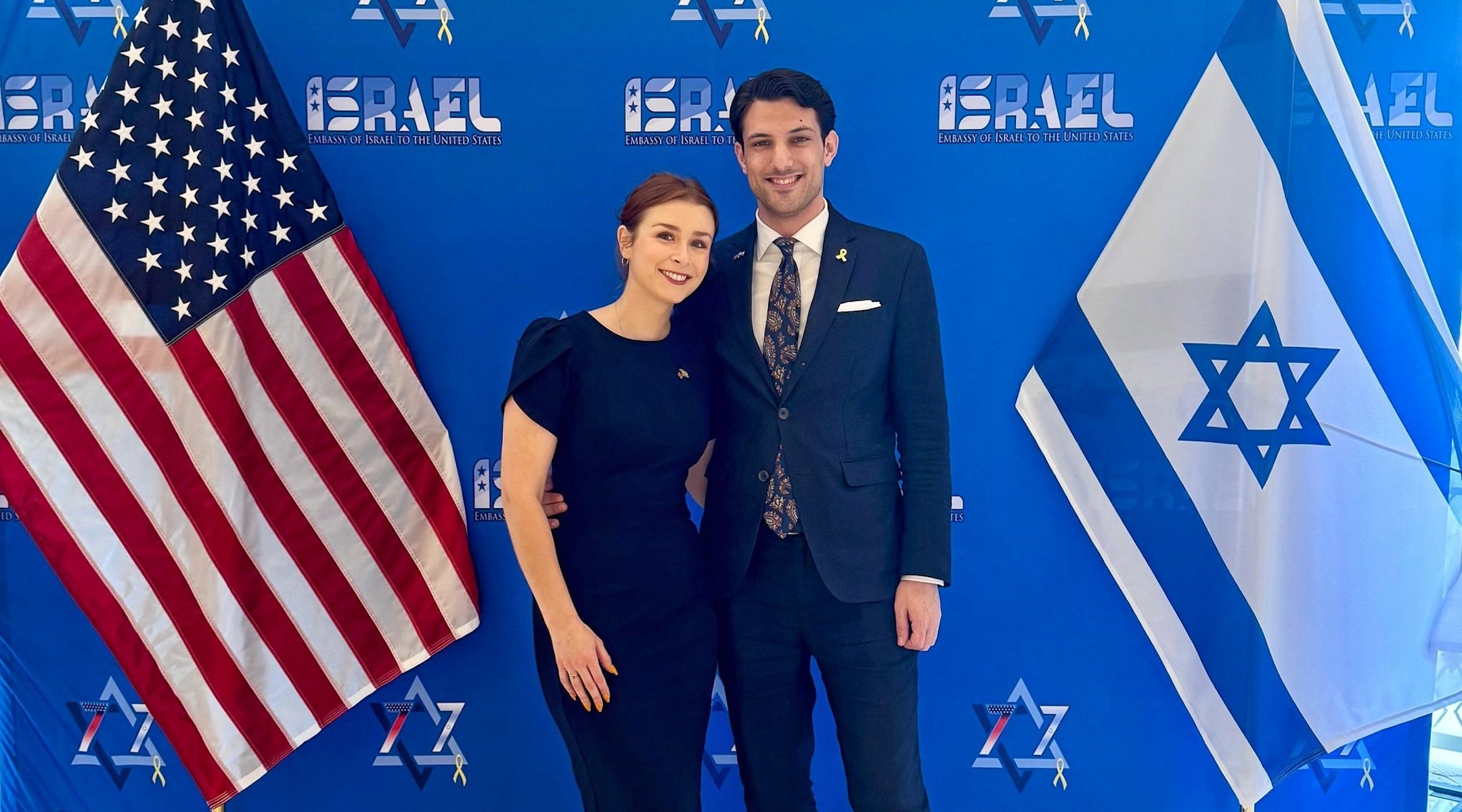
The repetition of such phrases has consequences, and those consequences played out Wednesday night in Washington D.C. when Sarah Milgrom and Yaron Lischinsky were murdered because they were Jews. As staff of the Israeli embassy, they attended an American Jewish Committee event at the Washington Jewish Museum. Upon leaving, they were assassinated in cold blood by Elias Rodriques, who was seen pacing outside the museum before the shooting. When he was arrested, he yelled, “Free, free Palestine.” The murder of young Israelis will not bring a resolution to this war; it will not result in whatever vision this perpetrator has to resolve the conflict.
Just last week, Yaron had purchased an engagement ring for Sarah. He was planning to propose next week in Jerusalem. The two of them believed in peace, and they worked to bring about mutual understanding. The event they attended was focused on bringing the interfaith community together and increasing humanitarian aid.
Reflecting on this heinous act of terror, I feel a mix of sadness and anger—and many of us also feel afraid. Some have expressed surprise in the aftermath, but I cannot. The ADL’s Pyramid of Hate reminds us that bias fuels insensitive remarks, which can ultimately escalate to violence.
But the question remains as to how we move forward. In our sadness, we remember this loving couple as agents of peace. With our fear, we remember that we work closely with our law enforcement partners to ensure our safety. And with our anger, we need to call on every person to recognize that such acts of violence only bring about further pain and will never bring peace.
In this moment, we need something else. We need resolve. Resolve is a firm determination to do something, to plan a course of action, or to find a solution to a problem. We know that antisemitism is at the highest levels ever recorded. There is antisemitism in our community stemming from the right and the left. To combat hate, we strive to humanize one another – which means we work on telling our story. To that end, we have planned to screen the film October 8 at Congregation Beth Tikvah on June 11 at 7 PM. It chronicles the rising antisemitism in the United States since the Hamas attacks. We will be doing this in partnership with several Worthington area churches. The program will be followed by a guided conversation.
Next, our resolve must include a commitment to understanding who we are as a Jewish people. We immerse in our rituals and holidays. We find meaning in the moments we come together to celebrate, and we enrich our journeys when we immerse in Torah in the broadest sense. This Torah includes reflecting on our story and our history from biblical times through modern times, from darkness to light. When we know who we are, our identity becomes stronger. Shabbat arrives tonight with profound sadness as we remember Sarah Milgrom and Yaron Lischinsky. May their memories be a blessing.
Shabbat Shalom,
Rabbi Rick Kellner
Singing Through the Silence
May 15, 2025
Basel, Switzerland is an important place in Jewish history. In 1897, Theodore Herzl gathered leaders from the European Jewish Community there for the world’s first World Zionist Congress. (Yes, it is the original iteration of the World Zionist Congress you just voted in!) The situation for the Jewish community in Europe was dire. Herzl, a journalist, had just covered the infamous Dreyfus affair in France, where French military leader, Alfred Dreyfus was wrongly accused and convicted of treason. The claims were false and solely based on antisemitism. He was later exonerated. Herzl, though not necessarily religious, was a proud Jew and he knew at the time, that something had to change. When he welcomed Jewish leaders to Basel, he said the following:
“We shall hear news of the situation of the Jews in different countries. All of you know, if only vaguely, that this situation, except for a few exceptional cases, is not a cause for joy. It is doubtful if we would be assembled here if the situation was otherwise. The uniformity of our destiny was interrupted by a long hiatus, though the scattered parts of the Jewish nation were condemned to share similar suffering in different places. Only in our times do we have the possibility, thanks to the modern miracle of transportation, to exchange information and create contact between the separated [communities]. And in this period, which is generally so uplifting, we see and sense ourselves everywhere surrounded by the ancient enmity. Anti-Semitism is the modern name, known to you so well, of this movement….
“Information about us in the world has always been defective due to distortion and obscuration. The feeling of [Jewish] belonging and cooperation, with which were accused so often and so stormily, was in the process of complete disintegration when we were assaulted by anti-Semitism, which awakened and amplified it once again. It can be said that we have returned home. Zionism is the return to Judaism even before the return to the land of the Jews.”
Herzl saw the moment, held a vision in his heart, and laid the foundation for the establishment of the modern State of Israel which would be born 51 years later. If you will it, it is no dream!
Fast forward 128 years and the eyes of Israelis and Jews are directed towards Basel, this time the host city for Eurovision. Each year there is a song contest in which each nation in Europe is able to submit one song. Last year, Eden Golan’s Hurricane spoke to the hearts of the Jewish people. Golan finished fifth thanks to an online vote but was probably penalized by the in-person judges because she was Israeli.
This year, Yuval Raphael’s entry speaks so powerfully to the soul of the Jewish people. I mentioned this song last week, but her story needs to be told. Raphael survived the Nova festival massacre by hiding in a shelter with 50 other people. While in the shelter, she recalled holding the hand of another girl and then a Hamas terrorist came in and started shooting. That girl had died. She was on the phone with her father who told her to, “hang up the phone and play dead.” Wounded with shrapnel, she survived by hiding under dead bodies for eight hours. Raphael was one of 11 in that shelter to survive. In November of 2024, she auditioned for HaKokhav HaBa, Israel’s version of Rising Star and was selected to represent Israel in Eurovision 2025. Her song for Eurovision is entitled New Day Will Rise and was written by Keren Peles.
Its lyrics are a blend of English, French, and Hebrew and reflect the true essence of Jewish history. We long for a time of comfort but our history has been filled with discomfort and uncertainty. The song speaks of the pain experienced on October 7th but also reminds us that a new day will rise and even if we are crying, we should not cry alone. “But we will stay, even if you say goodbye.” It is a reminder that survivors live on and that they must build a tomorrow, even with the sadness of grief.
Yuval Raphael enters this contest amid rising antisemitism. Some countries called upon the organizers to ban Israel; nothing new for Israel in this competition. She practiced being booed and even walked out in the introductions earlier this week to a man who made as throat slitting motion towards her. Semi-finals were held Tuesday and Thursday and Yuval Raphael performed yesterday. Tune in on Saturday for the finale! Click here to find out how you can watch the Eurovision Song Contest!
Shabbat Shalom
Rabbi Rick Kellner