
Written by Hannah Karr
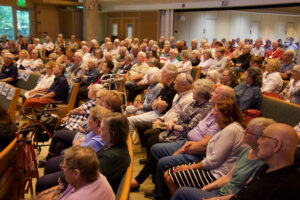
Parts of our collective Jewish story have remained hidden for generations behind the Iron Curtain. Jews who grew up under communism carried those experiences with them, and after immigrating, their stories became woven into the tapestry of American Jewish life, sometimes without being fully told. On Yom Kippur afternoon, Rabbi Rick Kellner invited Beth Tikvah congregants Adam Major, Polina and Inna Litvak, Mark and Yulia Bar, and Valia and Vitaly Bergelson to bring some of those stories into the light.
The program was part of Beth Tikvah’s ongoing effort to tell more of the totality of the Jewish story, including chapters that may be less familiar. The panelists’ experiences stretched across cities and generations, but common tensions resurfaced. For most of the group, Judaism was something they knew belonged to them without being introduced to the depth of what that meant.
For Adam Major, a defining reality of growing up under communism was the constant “distinction
between what you’re saying at home versus what you can talk about outside the house.”
Adam’s memory speaks to something broader than the concealment of Jewish practice. Growing up meant learning to monitor what you said and understanding that openness could carry consequences. Before a child could even begin to ask what being Jewish meant, there was already a lesson in secrecy; some parts of who you were belonged behind closed doors.
Polina and Inna Litvak remembered homes where pieces of Jewish life survived without being explained. Inna recalled growing up surrounded by family gatherings, her grandmother’s cooking, music, and Yiddish. Yet the reasoning behind these traditions remained unspoken. Even the Jewish history of their hometown, Kishinev, Moldova, the site of the 1903 pogrom, was largely absent from what they were taught.
For Mark Bar, Jewish identity carried an immediate sense of danger. He remembered being stopped on the street by older boys who targeted him because he was Jewish. “It was very, very challenging,” he said.
“I was very scared.”
For Valia Bergelson, reclaiming Judaism became an act of resistance. In 1971, after applying to leave the Soviet Union to move to Israel, she spent two years as a refusenik. During this time, she began studying Hebrew.
“It was very difficult to learn,” she remembered, “because there were no study books.” People turned to the few books found on the black market; they had to actively seek out the parts of their stories the Soviet system attempted to suppress.
“There was nothing to maintain. There was no Jewish life,” said Yulia Bar. She knew she was Jewish, but understood it as her nationality or ethnicity. “I had no idea it was a religion.”
Still, Judaism lived in the foods prepared by her family, the Yiddish conversations overheard at her grandparents’ home, and in an unspoken understanding that some things are better left unsaid. “It was kind of a secret,” Yulia recalled. “We don’t talk about it.”
She remembered her grandmother grating an apple and adding honey, a favorite childhood snack that she described as “the taste of my grandma’s house.” She wondered why none of her friends ate apples the same way. Only years later, after moving to Israel and experiencing Rosh Hashanah, did she understand what was preserved in her grandmother’s kitchen all along.
Yulia’s family story carries the scars of the Holocaust. Members of her family were murdered, while one of her grandfather’s brothers escaped as a teenager and eventually made his way to Columbus, Ohio. For 30 years, Yulia’s grandfather did not know what had happened to him. When the brothers finally reconnected in 1975, that reunion ultimately helped bring Yulia’s family to Columbus.
“Jewish story was not a religious thing,” she explained. “It was family history because we are Jews.”
Coming to the United States did not automatically restore all that was lost. Several congregants described discovering Judaism more deeply through their children and grandchildren, through PJ Library, the JCC, synagogue life, and other Jewish institutions.
As they became parents, Mark and Yulia realized that Jewish identity does not appear on its own. “If we don’t determine for ourselves who we are, someone will do it for us, and it won’t be a Jew,” said Yulia.
Our congregants who grew up under communist rule learned early how to conceal their Jewishness. The challenge then became intentionally creating Jewish lives for their children and grandchildren. They had to learn how to make Judaism visible, accessible, and joyful in once impossible ways.
When Rabbi Kellner asked what message they hoped others would carry forward from the conversation, Vitaly Bergelson answered: “Don’t be afraid to be a proud Jew.” His words gave voice to the transformation between the lives these panelists inherited and the ones they have proudly built.
“These stories are part of our collective story,” concluded Rabbi Kellner. “We are the sum of the stories that we tell about ourselves, and this is part of who we are.”
For decades, Soviet Jews were told what parts of themselves were safest left unspoken. Yet Jewish identity endured. It lived on in the Yiddish overheard at their grandparents’ house, matzah baked at home, apples mixed with honey, secret Hebrew and history lessons, and an active awareness that their differences connected them to something larger.
Questions left unanswered by years of Soviet suppression are still unfolding. By telling these stories, our congregants returned a once-hidden chapter to the collective Jewish story where it has always belonged.
Written by Hannah Karr, Director of Marketing & Community Engagement at Congregation Beth Tikvah
September 29, 2026