
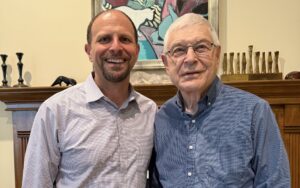
Featuring Earl Goldhammer
“I am very interested in art,” Earl began. “I knew nothing about art, absolutely nothing. I just loved the class.” He has always been willing to step into what he doesn’t yet understand. Years later, that instinct became a love language he shared with his wife, Karen.
“I met my wife and it turns out that she was an art lover too, but knew much, much more about art than I did. And so our life was very focused on art.” They traveled. They tried new things. They built a life around what they loved. “She was very devoted to Judaism. The thing that I looked forward to each year was our Seder.”
One year, Karen invited two nuns. “So it was a Seder with my wife and I and two nuns.” He paused, smiling as he remembered. “One of the nuns enjoyed the Seder so much… I was glad that she had a ride home.”
There is something about Earl’s presence that can be felt immediately. He meets people with an openness that does not ask for attention but holds it anyway. He cares deeply about those around him; he listens closely, responds thoughtfully, and makes space for others to be seen. His warmth is steady and comes naturally; it shows in the way he speaks and in a smile that is both gentle and unmistakably Earl.
Earl speaks about miracles and intervention with a kind of quiet certainty. He leaves space for them, the way one leaves space for a question that does not need to be answered right away. “Has God ever intervened in your life? My answer is yes.” In Jerusalem, standing at a locked gate, something happened. “A guy comes along. He pushed some buttons to let me in, and just as I got in, I turned around to thank him, and he disappeared.”
The moment still lingers—not because he can explain it, but because he cannot. He does not turn it into something larger than it is, but he doesn’t dismiss it either. He carries it alongside everything else he knows to be true. “I’m a math major and I was a tax lawyer. I don’t deal in fantasy very much.”
The people who shaped him remain close to his heart. “One of the most important people in my life was the cantor in my synagogue when I was a boy.” He remembers the time they spent together like it was yesterday. “He had numbers on his arm. He told me, ‘The reason I’m here is because the commander liked to hear me sing.’” What stayed with Earl was not only the story, but the standard. “Everything had to be just perfect.” And the music. “He taught me Jewish music that I never forgot. As an old man, I can still remember.”
His mother’s influence stands on its own. “I’ve never seen anybody work harder…She really gave me a sense of morality and a sense of purpose. She still influences my life every day.”
Alongside that influence came deep loss. When asked about life’s biggest challenges, Earl answered without hesitation: “My mother and my wife, both of whom were victims of cancer.”
When speaking about the loss of his wife, he does not soften what followed. “It was difficult… I had to have counseling because she was such a big part of my life that I needed help.” Still, he kept going. “I’ve had a very good life. Sometimes life comes with difficulties.”
Earl returns often to the topic of how people speak to one another. “We can discuss things and have different points of views and not get angry at one another.” He doesn’t see disagreement as something to avoid. “I think that we ought to emphasize that more. Different rabbis have different interpretations. That’s the way to exist, not fight with one another.”
As he looks back, there is no single defining moment, only a collection of life’s miracles. “I’m really lucky. I’m 84… I’m still here.” He lets that simmer. “That’s sort of a miracle too.
I have a lot to be thankful for.”
Earl Goldhammer was interviewed on March 5, 2026 by Rabbi Rick Kellner and Hannah Karr
Written by Hannah Karr, Director of Marketing & Community Engagement at Congregation Beth Tikvah
The Carob Tree Project is an initiative at Congregation Beth Tikvah designed to preserve the life stories, wisdom, and experiences of longtime congregants so their voices continue to guide the community long into the future. This project was started by Rabbi Rick Kellner and Hannah Karr, inspired by a story in the Talmud about Honi the Circle Maker. When asked why he is planting a tree that will take decades to bear fruit, he explains that just as others planted for him, he plants for the generations who will come after him. The lesson is about legacy, continuity, and responsibility across generations. In that spirit, the Carob Tree Project focuses on members of the congregation whose lives hold deep experience, reflection, and perspective. Through recorded interviews, participants are invited to share memories, formative moments, values, and lessons learned. These interviews are video recorded and archived, ensuring that their stories become a lasting resource for the community. Written profiles are then created from the interviews so that the insights and voices of these individuals can be shared more widely within the congregation. The goal is not simply to document history. It is to capture the human insight behind a life lived — the ideas, questions, and experiences that can nurture future generations. Just like the carob tree in the Talmudic story, the project recognizes that the fruits of a person’s life often extend far beyond their own lifetime. In this way, the Carob Tree Project becomes both an archive and a teaching tool: a living collection of stories that remind the community how wisdom is passed forward — one voice, one memory, and one life at a time.