
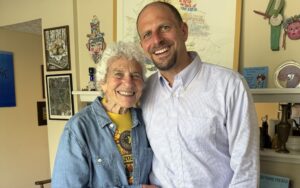
Featuring Mim Chenfeld
Mim Chenfeld has spent a lifetime bringing people together. She has always understood an ancient and essential lesson: people find their way into community through experiences and connection. Using song and movement, Mim has spent decades helping people feel what it means to belong. Wherever she goes, community closely follows.
“I always loved dancing,” she says simply. “I just dance.” If you trace her story carefully, you won’t find a straight line. You’ll find a rhythm.
Mim grew up in the Bronx, a world where diversity was a fact of daily life. Languages overlapped. Cultures collided. Synagogues existed in storefronts. Grandmothers spoke Yiddish and Russian and sold “dry goods” from pushcarts on the Lower East Side. Judaism was loud, bold, imperfect, and everywhere. She learned early how to speak her mind, how to embrace differences, and how to notice who was included and who was not.
In the early 1950s, just years after the founding of the State of Israel, Mim fell in love with Israeli folk dancing. She learned dances at retreats and studios and carried them home in her body, afraid that if she stopped moving, she would forget. She taught herself by repetition, walking through train stations rehearsing steps “so I wouldn’t lose it,” she says. “If I stopped, I’d never remember it.” And then, naturally, she taught others.
That instinct to preserve and pass on has shaped every part of her life, including her writing. Mim has always been a poet, attentive to language and image. She has published children’s books, including The House at 12 Rose Street, released in 1966 — one of the earliest children’s books in the United States to challenge conventions and provoke public conversation about what stories children are allowed to hear. Like her dancing and teaching, her writing trusted young people with complexity.
When Mim, her husband, Howard, and her family moved to Columbus in 1970, they passed synagogue after synagogue down the road to Congregation Beth Tikvah, housed in a small, warm, and homey building. “It was really the heimish feeling that sold us,” she recalls. Humanity was shining through the windows; intelligence and care lived side by side. Over the next 55 years, Beth Tikvah became the place where her children grew up, family milestones unfolded, and loyalty meant something deeper than convenience.
Her three children, Cara, Cliff, and Dan, all became b’nai mitzvah at Beth Tikvah, each finding their own way into Jewish life. Cliff later returned as a song leader, lending his voice to the community that helped shape him. Cara was married at the temple, another milestone held within walls already filled with memories. Today, Mim is the grandmother of seven grandchildren, and she recently celebrated the arrival of her first great‑grandchild, Leo, a new generation stepping into a story already rich with song, movement, and belonging.
Some of Mim’s most enduring work happened outside sanctuary walls. At Ohio State’s Hillel, she became a steward of folk dancing. Her dance group welcomed everyone: students and non-students, young and old, Jewish and not, people of every race and background. It was joyful, messy, cohesive, and alive.
10 years ago, Hillel’s folk-dance group was noticed beyond the circle itself. A Columbus newspaper columnist wrote about the group, capturing what made it special: people dancing and belonging together. The recognition affirmed what participants already knew. The group endured and continues today as the oldest folk dance group in Columbus.
Teaching, for Mim, was never about career ladders; it was about relationships. She taught public school, Hebrew school, preschoolers, adults, artists, and eventually teachers themselves. She helped build integrated arts programs long before the phrase was fashionable. She chose the Jewish Center over security and benefits because people had trusted her, and she would not abandon them. Decades later, strangers still approach her to say, “You came to my school. You changed how I teach.”
Ask Mim about happiness and she will not point to milestones. She will point to a walk, a good laugh, a story shared at the table. “Any day you can talk about is a good day,” she repeats her father’s words often and lives by them daily.
Her life philosophy comes in fragments, offered almost casually:
- “Ain’t no big thing.”
- “If this is the worst thing that ever happened, you’re doing okay.”
- “People spit in your eye, and you say it’s raining.”
Mim has protested, marched, raised children in movement spaces, brought toddlers to civil rights rallies, and taught them the words to freedom songs before they understood what they meant. She has lived through war, loss, political upheaval, and institutional failure without hardening. Her response has always been the same: make room; keep the circle open.
In the story of the carob tree, one plants knowing they may never eat the fruit. Mim Chenfeld planted dances she no longer leads, programs she no longer runs, and communities that still move to steps she once carried across train stations so they would not be lost.
Her legacy is not written. It is danced. Every time people gather, take hands, and move together — at Beth Tikvah, at Hillel, in classrooms, in sanctuaries, in ordinary moments — her tree is still bearing fruit.
Mim Chenfeld was interviewed on April 17, 2026, by Rabbi Rick Kellner and Hannah Karr
Written by Hannah Karr, Director of Marketing & Community Engagement at Congregation Beth Tikvah
The Carob Tree Project is an initiative at Congregation Beth Tikvah designed to preserve the life stories, wisdom, and experiences of longtime congregants so their voices continue to guide the community long into the future. This project was started by Rabbi Rick Kellner and Hannah Karr, inspired by a story in the Talmud about Honi the Circle Maker. When asked why he is planting a tree that will take decades to bear fruit, he explains that just as others planted for him, he plants for the generations who will come after him. The lesson is about legacy, continuity, and responsibility across generations. In that spirit, the Carob Tree Project focuses on members of the congregation whose lives hold deep experience, reflection, and perspective. Through recorded interviews, participants are invited to share memories, formative moments, values, and lessons learned. These interviews are video recorded and archived, ensuring that their stories become a lasting resource for the community. Written profiles are then created from the interviews so that the insights and voices of these individuals can be shared more widely within the congregation. The goal is not simply to document history. It is to capture the human insight behind a life lived — the ideas, questions, and experiences that can nurture future generations. Just like the carob tree in the Talmudic story, the project recognizes that the fruits of a person’s life often extend far beyond their own lifetime. In this way, the Carob Tree Project becomes both an archive and a teaching tool: a living collection of stories that remind the community how wisdom is passed forward — one voice, one memory, and one life at a time.