
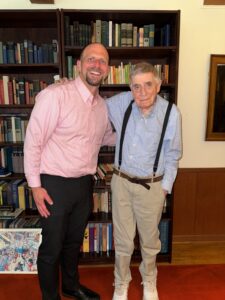
Featuring Gideon Fraenkel
Gideon Fraenkel’s story begins in Germany in 1932. His family history stretches back through Munich; wool brokers, rabbis, lawyers, and relatives who understood, early enough, that Germany was no longer safe. “In 1933, the whole bloody lot of them moved to Palestine,” he said. “They were clever.” After Hitler came to power, British scientists came to Germany looking for scholars they could help bring back. “They got Dad a job at a university college, and so we moved to England.”
“A defining event of my life was the Second World War.” He was only a boy when the Blitz began. He remembers sleeping under the stairs with his younger brother because “that was a safe place,” while his parents slept under a heavy steel table. Soon the family moved west of London to Slough, where his father’s research had been relocated. There, wartime life took on a quieter rhythm; he remembers a nice house, a vegetable garden, and a sense of adaptation. “It was a rather quiet war, to tell you the truth,” he says.
School didn’t always hold his attention. “I was a rather bad student,” he admits. But then two subjects changed everything: history, because it simply happened, and chemistry, because it offered something irresistible: “you could mix things up, make a stink, and blow things up.” He and a few friends began turning his bedroom into a laboratory of small explosions and improvised fireworks; the reckless joy of boys who had discovered a messy form of wonder. “The funny thing is,” he says, “each of us became an academic chemist.”
That joy in experimentation never left him. Science became one of the great forces of Gideon’s life. He entered the field just as Nuclear Magnetic Resonance (NMR) was emerging, a technique that allowed chemists to see molecular structures in ways they never had before. “I was one of the early chemists who started using this to solve problems,” he says. “That was why I became well-known quite quickly.”
When he speaks about his work, he describes it with an exhilaration, as if he can see the memories dancing in front of him. “We were always in the forefront.” He recalls the chemistry departments in the 1950s, 60s, and 70s staying alive late into the night, with students and faculty alike pulled along by the thrill of discovery.
At the time, public investment in research created room for ideas to flourish and for young scientists to build lives in discovery. “You could get money to pursue research,” he says. It was a golden age—a world where curiosity was rewarded with possibility. While consulting for Goodyear, Gideon helped solve a dangerous problem with airplane tires that were bursting on landing. “I knew about the catalysts because we were interested in lithium compounds,” he explained. The solutions he and his partner implemented “must have saved the country millions in deaths, injuries, aircraft damage and so on.”
For all the exhilaration of scientific discovery, some of the deepest joy in Gideon’s life came from building a life with Alice. He tells their shared story with warmth and a glint of mischief. When she first opened the door to him, he says, she later confessed that she thought to herself “she’d like to have one of those.” A year later, they were married.
“In the beginning you’re in love,” he says, “and then later on you’re just best friends.” Alice died in 2016, but his admiration for her is unmistakable — for her mind, her ambition, and the life they built together.
Gideon speaks proudly of his children and grandchildren, of their intelligence, their individuality, and the ways they surprised him. But he is also candid about regret. “Probably should have paid more attention to my children,” he says. Gideon’s honesty is one of the qualities that makes him so compelling. He doesn’t try to pretend that life can be smoothed into a polished lesson.
Judaism runs through Gideon’s life as a culture, an inheritance, and a way of belonging. His father “knew the entire Torah by heart” a legacy of his Orthodox upbringing in Munich. At Beth Tikvah, Gideon continues to learn, read, argue, and think. The Jewish habits of interpretation and questioning seem to suit him.
Gideon remains animated by the same forces that shaped the child mixing chemicals in his bedroom. He talks eagerly about science, public research, energy, electric cars, heat pumps, and the future of universities. He still writes, questions, and critiques. He still wonders.
“I tell you one thing I regret,” he says, half-smirking. “I never bought myself a Miata.”
Gideon’s life has been shaped by history, sharpened by science, and sustained by curiosity. He has spent a lifetime asking questions others had not yet learned to ask. And even now, when he speaks about discovery, that youthful spark returns.
The experiment, it seems, is not over yet.
Written by Hannah Karr, Director of Marketing & Community Engagement at Congregation Beth Tikvah
Gideon Fraenkel was interviewed on May 20, 2026 by Rabbi Rick Kellner and Hannah Karr.
The Carob Tree Project is an initiative at Congregation Beth Tikvah designed to preserve the life stories, wisdom, and experiences of longtime congregants so their voices continue to guide the community long into the future. This project was started by Rabbi Rick Kellner and Hannah Karr, inspired by a story in the Talmud about Honi the Circle Maker. When asked why he is planting a tree that will take decades to bear fruit, he explains that just as others planted for him, he plants for the generations who will come after him. The lesson is about legacy, continuity, and responsibility across generations. In that spirit, the Carob Tree Project focuses on members of the congregation whose lives hold deep experience, reflection, and perspective. Through recorded interviews, participants are invited to share memories, formative moments, values, and lessons learned. These interviews are video recorded and archived, ensuring that their stories become a lasting resource for the community. Written profiles are then created from the interviews so that the insights and voices of these individuals can be shared more widely within the congregation. The goal is not simply to document history. It is to capture the human insight behind a life lived — the ideas, questions, and experiences that can nurture future generations. Just like the carob tree in the Talmudic story, the project recognizes that the fruits of a person’s life often extend far beyond their own lifetime. In this way, the Carob Tree Project becomes both an archive and a teaching tool: a living collection of stories that remind the community how wisdom is passed forward — one voice, one memory, and one life at a time.